| Images |
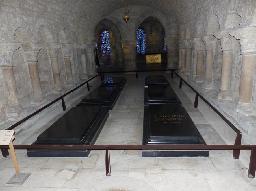 Royal tombs at the Basilique Saint-Denis, Paris. Picture by Androom (20 Feb 2016) |
Louis XVIII, Roi de France |
| MONARCH (FRANCE) |
|
BORN 17 Nov 1755, Versailles, Yvelines - DIED 16 Sep 1824, Paris: Palais des Tuileries BIRTH NAME Louis Stanislaus Xavier de Bourbon CAUSE OF DEATH gangrene in both feet GRAVE LOCATION Saint-Denis, Seine-Saint-Denis: Basilique Cathédrale de Saint-Denis (in the center of the crypt) |
|
Louis XVIII was the fourth son of Dauphin Louis, the son of Louis XV, and his second wife Marie-Josèphe of Saxony. His oldest brother Louis-Joseph died in 1761 and this placed him second in line after his brother Louis Auguste, the future Louis XVI and before the future Charles X. He was educated at the Palace of Versailles, and he was known as the Count of Provence. On 14 May 1771 he married Marie Joséphine of Savoie. her sister Marie Thérèse would marry his brother Charles. In 1774 his brother became King but this did not stop Louis from criticizing him. After the royal family was forced to leave Versailles and live in Paris in 1789, he inhabited the Petit Luxembourg. When Louis XVI tried to escape from Paris on 20 June 1791, the Count of Provence left his house af well. He reached the Austrian Netherlands without a problem and settled in Brussels and later in Koblenz. In 1792 he tried to return to France but after the Battle of Valmy he fled to Hamm in Westphalia. After his brother was executed and his son died in 1795, he took the title of Louis XVIII. From 1794 to 1796 he lived in Verona. One month after his departure Bonaparte entered the city. He lived in Riegel, Brunswick, Mittau and Warsaw until 1804. In 1804 Napoleon requested King Frederick William of Prussia to end his hospitality and Louis XVIII moved to Sweden and later to Latvia. From 1807 to 1812 he settled in England at Gosfield Hall in Essex. In 1809 he moved to Hartwell House in Buckinghamshire, where his wife died on 13 November 1810. After Napoleon was defeated in 1814 the Allies hesitated to place him on the throne of France because of his unpopularity, but Talleyrand managed to convince them to restore the Bourbon monarchy. On 3 May 1814 he arrived in Paris. But after the French failed to pay Napoleon his pension and he became aware of the unpopularity of Louis XVIII, he returned from Elba to France on 1 March 1815. Initially it was expected that Napoleon would soon be taken prisoner or killed, but the army supported him and on 19 March he arrived at the gates of Paris. Louis fled to Ghent, where he lived during the 100 Days. After Napoleon's defeat at Waterloo he returned to Paris. Many were aware that he was twice placed on the throne with the help of foreigners and had fled immediately after Napoleon's return and he was not popular. He resided in Paris and the Palace of Versailles was uninhabited during his reign. He suffered from diabetes and gout and had to walk with crutches or was moved around in a wheelchair. Bonapartists and also common people called him Pig XVIII. In 1824 he died at the Palais des Tuileries, and he was buried at the Basilica of Saint-Denis. Related persons • has a connection with Barras, Paul, vicomte de • was painted by Genod, Michel-Philibert • employed Gérard, François • was painted by Lefèvre, Robert Events |
| 1/2/1814 | The Bourbons promise liberal policies in a proclamation. Louis XVIII and Charles X were still in England. But Napoleon's regime was close to collapsing and they tried to win the support of the French people. [Charles X, King of France][Napoleon I Bonaparte] |
| 6/4/1814 | Napoleon abdicates at Fontainebleau. He had tried to abdicate in favour of his son but this was rejected by the allied forces. He was to receive Elba as kingdom. On the same day it was determined that 'Louis de France, frère du dernier roi' would receive the throne of France. [Napoleon I Bonaparte] |
| 12/4/1814 | Charles, Count of Artois accepts power in France in the name of his brother Louis XVIII [Charles X, King of France] |
| 16/4/1814 | The Treaty of Fontainebleau is ratified. Napoleon was sent to Elba with a substantial pension and the throne of France would be returned to Louis XVIII. [Napoleon I Bonaparte] |
| 30/5/1814 | First Peace of Paris: France is reduced to its borders from 1792. Talleyrand represented Louis XVIII and held peace talks with Britain, Russia, Austria and Prussia. All five nations signed the treaty that ended the War of the Sixth Coalition. The persons who signed the treaty were Talleyrand (for France), Lord Castlereagh, Lord Aberdeen, Earl Cathcart (for Britain), Count Razumovsky, Karl Nesselrode (for Russia), Prince Metternich, Count Stadion (for Austria), Baron Hardenberg and Wilhelm von Humboldt (for Prussia). [Charles X, King of France] |
| 20/1/1815 | The remains of Louis XVI and Marie-Antoinette are transferred to Saint Denis. Like many victims of the guillotine he was buried in an anonymous grave at the Madeline Cemetery. It was closed on 25 March 1794. In 1802 the land where the bodies lay was bought by Pierre Louis Olivier Desclozeaux, who sold it to Louis XVIII on 11 January 1811. The bodie were exhumed on 18 and 19 January and moved to the Saint Denis Basilica on 20 January, where they were reburied on 21 January. The remains of Marie Antoinette were identified by a garter and a jaw. [Louis XVI Auguste, King of France][Marie Antoinette, queen of France] |
| 19/3/1815 | Louis XVIII flees from Paris to Lille. After Napoleon's landing in France, he had tried to placate the people with liberal proclamations. However, the behavior of the old nobles and clergy, led by his brother Charles of Artois, had caused too much bad blood. He fled during the night of March 19 to 20 to Lille. It was not easy to lift him into his carriage given his weight and because he was gouty. Because the ganirson in Lille seemed hostile they continued to Ghent in Belgium. [Charles X, King of France][Napoleon I Bonaparte] |
| 20/3/1815 | Napoleon arrives in Paris. He travelled from Pont-sur-Yonne and reached Fontaineblueau in the night from 19 to 20 March. A few hours he continued to the Tuileries, where he arrived in the morning. In the same night Louis XVIII fled from Lille to Ghent. [Napoleon I Bonaparte] |
| 23/3/1815 | Louis XVIII travels from Lille via Ostend to Ghent. Napoleon appeared before the gates of Paris on 19 March and he had fled the city. [Napoleon I Bonaparte] |
| 8/7/1815 | Louis XVIII returns to Paris again. He had followed the Allied troops on a safe distance and after the troops had occupied Paris entirely he publicly entered the city. He was welcomed by Gaspard de Chabrol, who famously said "Sire, cent jours se sont écoulés depuis le moment fatal où Votre Majesté, forcée de s’arracher aux affections les plus chères, quitta la capitale au milieu des larmes et de la consternation publique". |
| 9/7/1815 | Louis XVIII celebrates a festive entry into Paris. He had already done the same on 3 May 1814 after Napoleon's first abdication. He is protected by Arthur Wellesley, Duke of Wellington. [Wellington, Arthur Wellesley, 1st Duke of] |
| 24/7/1815 | Louis XVIII issues list of executions. Besides the names of persons who were to be executed, the list also contained the names of persons who were to be banished. Marshal Ney was at the top of the death list. Colonel La Bédoyère and General Lavalette were also on this list. [La Bédoyère, Charles, Comte de][Lavalette, Antoine-Marie Chamans, Comte de][Ney, Michel, Duc d’Elchingen, Prince de la Moskowa] |
| 12/1/1816 | The Bonaparte family is banished from France territory. It was also decided that all members of the Convention who had voted in favour of the death of Louis XVI ('the murderers of the king') had to leave France. |
| Images |
|
Royal tombs at the Basilique Saint-Denis, Paris. Picture by Androom (20 Feb 2016) |
Sources • Longford, Elizabeth, Wellington, Pillar of State, Panther Books, Frogmore, 1975 • Longford, Elizabeth, Wellington, The Years of the Sword, World Books, London, 1971 • Vanoyeke, Violaine, Les Bonaparte, Criterion, Paris, 1991 • Winkler Prins Encyclopedie (editie 1909), 1909 • Madeleine Cemetery - Wikipedia (EN) • Treaty of Paris (1814) - Wikipedia (EN) |


